
NASA’s Johnson Space Center in Houston, Texas holds the title as the agency’s largest facility dedicated to human spaceflight, spanning 1,620 acres and serving as mission control for crewed missions since the Gemini program. But size isn’t measured in acreage alone. Kennedy Space Center’s 144,000-acre Florida complex claims the spatial crown, while Marshall Space Flight Center in Alabama leads in rocket propulsion expertise. What makes these centers truly significant for students and developers today is their transformation from closed government facilities into collaborative hubs actively seeking fresh perspectives through open-source initiatives and challenge programs.
These aren’t distant institutions behind security gates. Each center now operates hackathons, publishes open datasets, and invites university teams to solve real engineering problems. A sophomore from Arizona helped refine lunar habitat designs through a Marshall-led challenge. A graduate developer contributed code to Johnson’s mission planning software. These collaboration stories aren’t rare exceptions, they represent a deliberate shift in how NASA engages emerging talent.
Understanding which center does what and how you can participate requires looking past the “biggest” label. Johnson trains astronauts and manages flight operations. Kennedy launches spacecraft. Marshall builds propulsion systems. Each offers different entry points for contributors, whether you write code, study engineering, design interfaces, or analyze data. The pathway from curious student to active NASA collaborator is more accessible than most realize, and it starts with knowing where your skills align with ongoing projects.
What NASA’s Biggest Space Centers Are
When people ask about NASA’s biggest space centers, they’re usually measuring by workforce size, physical footprint, or mission importance. All three metrics matter, but they don’t always align. Johnson Space Center in Houston employs over 10,000 civil service and contractor personnel, making it NASA’s largest by headcount. Kennedy Space Center in Florida claims the biggest land area at 144,000 acres along the Atlantic coast. Meanwhile, Marshall Space Flight Center in Huntsville, Alabama, leads in propulsion expertise and university collaboration volume. Each center earned its “biggest” status through decades of specialized work that draws researchers, engineers, and students from around the world.
Johnson Space Center sits on 1,600 acres southeast of Houston and serves as mission control for the International Space Station. Astronauts train there in the Neutral Buoyancy Laboratory, a massive pool holding 6.2 million gallons of water where they practice spacewalks. The center also houses the largest collection of lunar samples on Earth and runs active programs in robotics, life sciences, and spacecraft design. For students interested in human spaceflight, this is where theory meets operational reality.
Kennedy Space Center’s sprawling campus includes the iconic Vehicle Assembly Building, one of the largest single-story buildings ever constructed. At 525 feet tall, it can fit the Statue of Liberty inside with room to spare. The center manages all NASA launch operations, from stacking rockets to final countdown. Its proximity to Cape Canaveral Space Force Station creates a dense ecosystem of aerospace contractors, startups, and research groups. Students participating in university CubeSat programs often see their work culminate here when payloads reach the launch pad.
Marshall Space Flight Center designed the Saturn V rocket that sent astronauts to the Moon and now leads development of the Space Launch System. The center maintains close ties with universities across the Southeast, hosting student competitions, research partnerships, and co-op programs that welcome international participants. Its focus on propulsion and structural engineering attracts mechanical and aerospace students, but software developers find opportunities too, modern rocket systems run on millions of lines of code that need testing, simulation, and continuous improvement.
What These Centers Do: Mission Areas and Innovation Hubs
Human Spaceflight and Astronaut Training
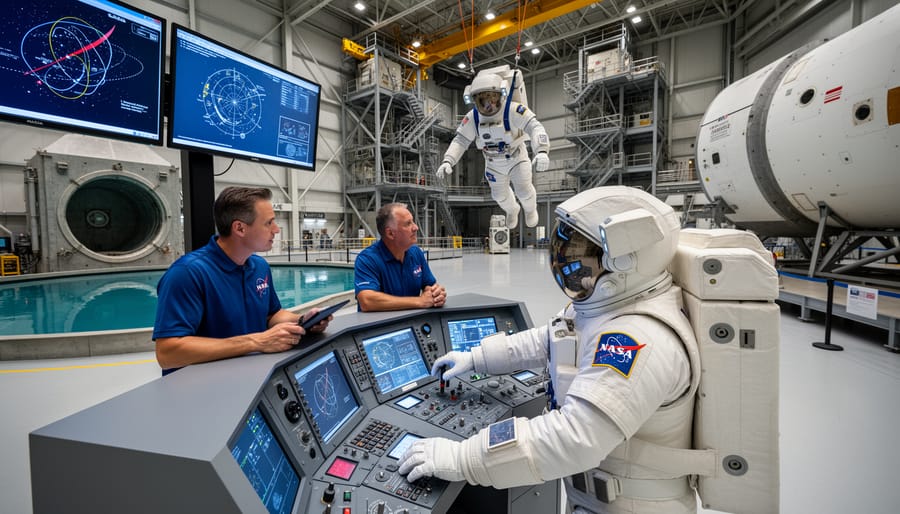
Johnson Space Center in Houston serves as NASA’s hub for human spaceflight operations, housing the iconic Johnson Space Center mission control where flight controllers guide missions from launch through landing. The center trains every NASA astronaut, operating the Neutral Buoyancy Laboratory, a 6.2-million-gallon pool where crews rehearse spacewalks in full suits, and high-fidelity simulators that replicate spacecraft systems down to switch positions and failure scenarios.
What makes Johnson particularly valuable for students and researchers is its openness to collaborative projects. University teams regularly contribute to life support experiments, habitat design prototypes, and human factors research through NASA’s Flight Opportunities program and academic partnerships. The center also hosts the annual Human Exploration Rover Challenge, where student teams build and race moon buggies, gaining hands-on engineering experience and direct feedback from astronaut trainers.
These programs thrive on student-educator collaboration pairing academic mentorship with real mission requirements. Johnson’s research divisions actively seek fresh perspectives on radiation shielding, exercise equipment, and closed-loop environmental systems, problems where student ingenuity has led to flight-ready solutions.
Launch Operations and Spacecraft Assembly
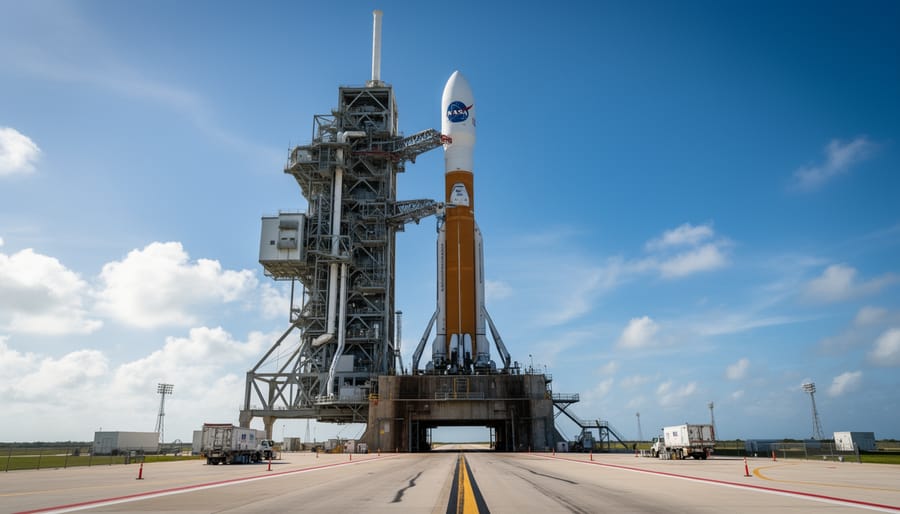
Kennedy Space Center in Florida operates as NASA’s primary launch complex, where spacecraft transition from concept to orbit. The center’s Vehicle Assembly Building stands 525 feet tall, one of the largest single-story buildings by volume anywhere, designed to stack rockets vertically before transport to the pad. This is where Artemis missions come together, massive Space Launch System rockets assembled piece by piece alongside Orion crew capsules.
Launch Complex 39, which sent Apollo astronauts to the moon, now hosts both NASA and commercial launches. Students can witness this infrastructure through the center’s extensive visitor programs. The Kennedy Space Center Visitor Complex offers behind-the-scenes tours of active facilities, letting you see engineers preparing real missions. University groups frequently arrange educational visits that go beyond tourism, you’ll meet payload integration teams, learn about launch sequencing, and understand how open-source flight software gets tested before deployment.
The center actively shares launch data and engineering documentation through public channels, making it valuable for students building simulation projects or studying aerospace systems. If you’re developing tracking apps or visualization tools, Kennedy’s launch schedules and telemetry standards provide real-world data to work with.
Propulsion, Engineering, and Student Collaboration
Marshall Space Flight Center in Huntsville, Alabama, stands as NASA’s lead center for propulsion systems and heavy-lift rocket development. The facility designs and tests engines for missions like Artemis, while simultaneously running robust university partnership programs that bring students directly into active research. Through initiatives like the University Student Launch competition and research fellowships, undergraduates work alongside engineers on real propulsion challenges, testing rocket components, analyzing thermal dynamics, and contributing to open-source simulation tools. Marshall’s collaborative model treats students as junior colleagues rather than observers, offering hands-on experience with the same computational fluid dynamics software and testing protocols used in professional spaceflight programs.
Who These Programs and Opportunities Are For
NASA’s biggest space centers aren’t reserved for aerospace PhDs or astronaut candidates, they’re deliberately built to engage a wide spectrum of talent, from first-year undergrads to self-taught developers working on weekend projects. If you’re curious about space technology and willing to contribute, there’s a pathway in.
The programs, challenges, and open resources described throughout this article serve multiple communities:
- Computer science and engineering students building portfolios and seeking real-world project experience
- Open-source contributors looking for high-impact repositories with active maintainer communities
- Educators designing curriculum around space data, robotics, or Earth observation
- Industry professionals exploring collaboration opportunities or career transitions into aerospace
- Hobbyist developers and space enthusiasts who want to collaboration tactics on meaningful projects
You don’t need an aerospace engineering degree to contribute to open source projects that support NASA missions. Students from mathematics, data science, environmental studies, design, and even communications have successfully participated in Space Apps 2026 and other center-affiliated initiatives. Canadian and international participants face no citizenship barriers for most hackathons, open datasets, or collaborative research, though formal internships have more restrictive eligibility. Universities across Canada have established partnerships and mentorship networks, and many Canadian university projects have directly leveraged NASA’s public APIs and documentation.
The common thread isn’t your major or your passport, it’s curiosity paired with the willingness to learn in public, contribute incrementally, and collaborate across disciplines. Whether you’re debugging Python scripts for satellite data processing or designing user interfaces for mission visualization tools, NASA’s largest centers provide the datasets, challenges, and community support to turn your interest into tangible impact.
How to Engage: Participating in NASA Programs and Challenges
NASA Space Apps Challenge: Your First Step
The NASA Space Apps Challenge represents the most accessible gateway into NASA’s ecosystem, a global hackathon that welcomes anyone with curiosity and a willingness to collaborate, regardless of technical background or citizenship. Held annually over a single October weekend, this event connects participants with real NASA data, mentorship from space professionals, and challenges spanning everything from Earth observation visualization to Mars habitat design.
You don’t need prior space experience. Teams typically form organically at local host sites or online, mixing developers with designers, educators, scientists, and storytellers. The beauty lies in this diversity, winning projects often come from interdisciplinary groups that combine coding skills with domain knowledge or creative communication.
Challenges range from beginner-friendly data visualization tasks to complex algorithm development, always grounded in actual NASA missions and datasets. Past participants have built wildfire tracking apps using satellite imagery, designed asteroid deflection simulations, and created educational VR experiences explaining climate data, all within 48 hours.
The tangible outcomes extend far beyond the weekend. Many participants leverage their Space Apps projects as portfolio pieces for internship applications. Others continue developing their solutions as open-source tools used by researchers globally. Some teams have parlayed their challenge experience into NASA Pathways positions or leadership roles in space-focused open-source communities, proving that your first meaningful contribution to space exploration can happen from your university library or living room.
Open Data, APIs, and Developer Resources
NASA’s open data ecosystem removes traditional barriers to space research, giving students and developers direct access to the same resources used by professional scientists and engineers. The agency publishes thousands of datasets through, covering everything from Mars rover imagery and satellite climate data to exoplanet discoveries and International Space Station telemetry. These aren’t simplified educational versions, they’re production-grade scientific data that you can analyze, visualize, and build real applications around.
For developers, NASA’s API portfolio offers ready-made integration points. The Astronomy Picture of the Day API delivers daily space imagery with metadata; the Earth Observation API provides satellite views of any location on Earth; and the NASA Image and Video Library API grants programmatic access to the agency’s media archive. All are free, require minimal authentication, and come with clear documentation designed for newcomers.
NASA’s GitHub organization hosts over 400 active repositories, from mission planning software to machine learning models trained on planetary data. You can fork these projects, contribute improvements, or study production code from missions like Perseverance and Artemis. Many repositories welcome first-time contributors and include “good first issue” tags specifically for students building their open-source portfolios.
Internships, Co-ops, and Academic Partnerships
NASA Pathways offers undergraduate and graduate internships at major centers like Johnson, Kennedy, and Marshall, with some positions open to permanent residents and international students through university partnerships. Co-op programs run year-round, letting you alternate semesters between campus and hands-on work in mission control, propulsion labs, or data science teams.
Canadian students face citizenship restrictions for many NASA roles, but can participate through joint research agreements between their universities and NASA centers, programs like the Canadian Space Agency’s collaboration with Johnson Space Center or cross-border research grants. Universities with established NASA partnerships often secure slots for international students on specific projects. Check your school’s aerospace or engineering department for existing MOUs, or look into Space Grant Consortiums that include Canadian institutions as affiliate members.
Real Student and Collaboration Stories
When Maya Rodriguez joined the 2023 NASA Space Apps Challenge as a computer science sophomore at the University of Toronto, she had no prior space industry experience. Her team tackled a challenge involving exoplanet data visualization using NASA’s open datasets from the Kepler mission. What started as a weekend hackathon turned into a year-long collaboration with researchers at the Ames Research Center. Maya’s team developed an open-source tool now used by educators in twelve countries, and she secured a summer research position at Ames the following year. “I thought NASA was only for aerospace engineers,” she recalls. “Space Apps showed me that my coding skills could contribute to real missions.”
At the Johnson Space Center, a collaboration between Georgia Tech students and the Human Research Program yielded unexpected results. The student team, led by biomedical engineering major James Chen, worked on analyzing astronaut health data patterns. Their machine learning model identified correlations that hadn’t been previously documented, leading to a co-authored paper and an invitation to present findings at a space medicine conference. James is now pursuing graduate research in aerospace medicine, directly influenced by that initial student project.
The Marshall Space Flight Center’s university partnership program connected a team from the University of Waterloo with propulsion engineers working on next-generation rocket systems. The students contributed thermal modeling code to an open-source simulation tool, gaining hands-on experience with real engineering constraints. Team member Sarah Okonkwo describes the experience as transformative: “We weren’t just doing academic exercises. Our code had to work for actual mission planning scenarios.”
These stories share common threads: students discovering unexpected pathways into space technology, skills developed through practical application rather than theory alone, and the realization that space exploration welcomes diverse talents. The collaborative, open-access approach championed by NASA’s centers has lowered barriers and created genuine opportunities for students to contribute meaningfully to space missions.
Who It’s For
This article is for university students, open-source developers, and educators who want to understand how NASA’s largest facilities translate into real participation opportunities, not just read about them from a distance.
If you’re a computer science, engineering, or data science student looking for meaningful projects beyond coursework, these NASA centers offer competitions, datasets, and challenges that build portfolio-worthy work. You don’t need prior aerospace experience. Many successful participants started with web development, Python scripting, or design skills and learned space applications through doing.
Open-source contributors will find this guide valuable for discovering NASA’s public APIs, GitHub repositories, and collaborative projects that welcome outside developers. These aren’t token gestures, NASA actively uses community contributions in research and mission support.
Educators seeking to connect students with real-world STEM applications can use this resource to identify programs, challenge events, and partnership opportunities that bring space exploration into the classroom without requiring NASA employment or U.S. citizenship.
If you’re curious whether space work is accessible to someone with your background and location, this article answers that question with specific pathways rather than vague encouragement.
Common Questions About NASA Center Engagement
Do I need to be a U.S. citizen to participate in NASA programs?
No, for the NASA Space Apps Challenge and most open-source initiatives. The hackathon is a global event open to anyone, anywhere, and NASA’s public datasets and APIs have no citizenship restrictions. However, formal internships and some facility-based programs may require U.S. citizenship or permanent residency due to federal employment rules.
Can I participate remotely, or do I need to visit a NASA center?
Most engagement opportunities are remote-friendly. Space Apps teams can compete from local host sites or virtually, open-source contributions happen entirely online, and you can explore NASA datasets from your dorm room. Physical visits are only needed for specific internships or on-site research collaborations.
What skills do I actually need to get started?
You need curiosity more than credentials. Space Apps challenges welcome beginners and offer problems suited to designers, storytellers, and data analysts, not just coders. If you can learn, research, or collaborate, you have enough to contribute.
What if I’m not an engineering major?
NASA’s work spans far beyond engineering. Centers need expertise in education, communication, environmental science, policy, and creative fields. Space Apps specifically seeks diverse skill sets, and many winning teams include non-technical members who bring storytelling, user experience design, or scientific research skills.
The competitive nature of NASA programs varies widely by pathway. Space Apps has no application rejection, you register and participate. Open-source contributions depend entirely on the quality of your code or documentation, not your resume. Internships and Pathways programs are selective, yes, but they evaluate potential and learning capacity as much as existing expertise.
Canadian students face fewer barriers than many realize. Space Apps hosts events in multiple Canadian cities each year, and NASA’s open data carries no border restrictions. University partnerships between Canadian institutions and NASA centers create research opportunities that don’t require relocation. The key is starting with accessible programs like hackathons and open-source projects to build demonstrable skills, then leveraging those experiences into formal pathways.
Whether you’re a computer science student curious about satellite data, an engineering major dreaming of rocket design, or simply someone who wants to contribute to humanity’s next giant leap, NASA’s biggest space centers offer a pathway in. The barriers that once separated space exploration from everyday participation have crumbled in the open-source era.
Start small. Browse NASA’s open datasets this weekend. Form a team for the next Space Apps Challenge. Fork a repository from one of NASA’s GitHub projects and improve the documentation. Reach out to your university’s research office about existing NASA partnerships you didn’t know existed.
These centers, Johnson, Kennedy, Marshall, and others, aren’t distant fortresses of exclusive expertise. They’re collaboration hubs actively seeking fresh perspectives, diverse skill sets, and innovative thinking from students and developers worldwide. Your geographic location, your major, even your current skill level matter less than your willingness to engage.
The next breakthrough in space technology might come from a hackathon team in Toronto, a GitHub contributor in Mumbai, or a student project at your campus. Space exploration has become genuinely inclusive, genuinely collaborative. Your first step doesn’t require a passport or a PhD. It just requires you to begin.